I co-authored two papers about Elite from the 2026 IEEE Conference on Games
Two bona fide academic papers on BBC Micro Elite were presented at the IEEE Conference on Games in Madrid in September 2026.
I'm a co-author, alongside Michael Fairbank from the University of Essex.
They're a great read! And they're available as free downloads from the University of Essex website, so everyone can enjoy them.
Here are the details. I hope you like them; they were certainly fun to work on.
The Rotating Planets in the Classic Game: Elite
-----------------------------------------------
The first paper is all about the in-game planets, with their glorious rotating craters and meridians.
Fairbank, Michael and Moxon, Mark (2026) The Rotating Planets in the Classic Game: Elite. In: IEEE Conference on Games, 2026-09-01 - 2026-09-04, Madrid.
Free download: https://repository.essex.ac.uk/43577/
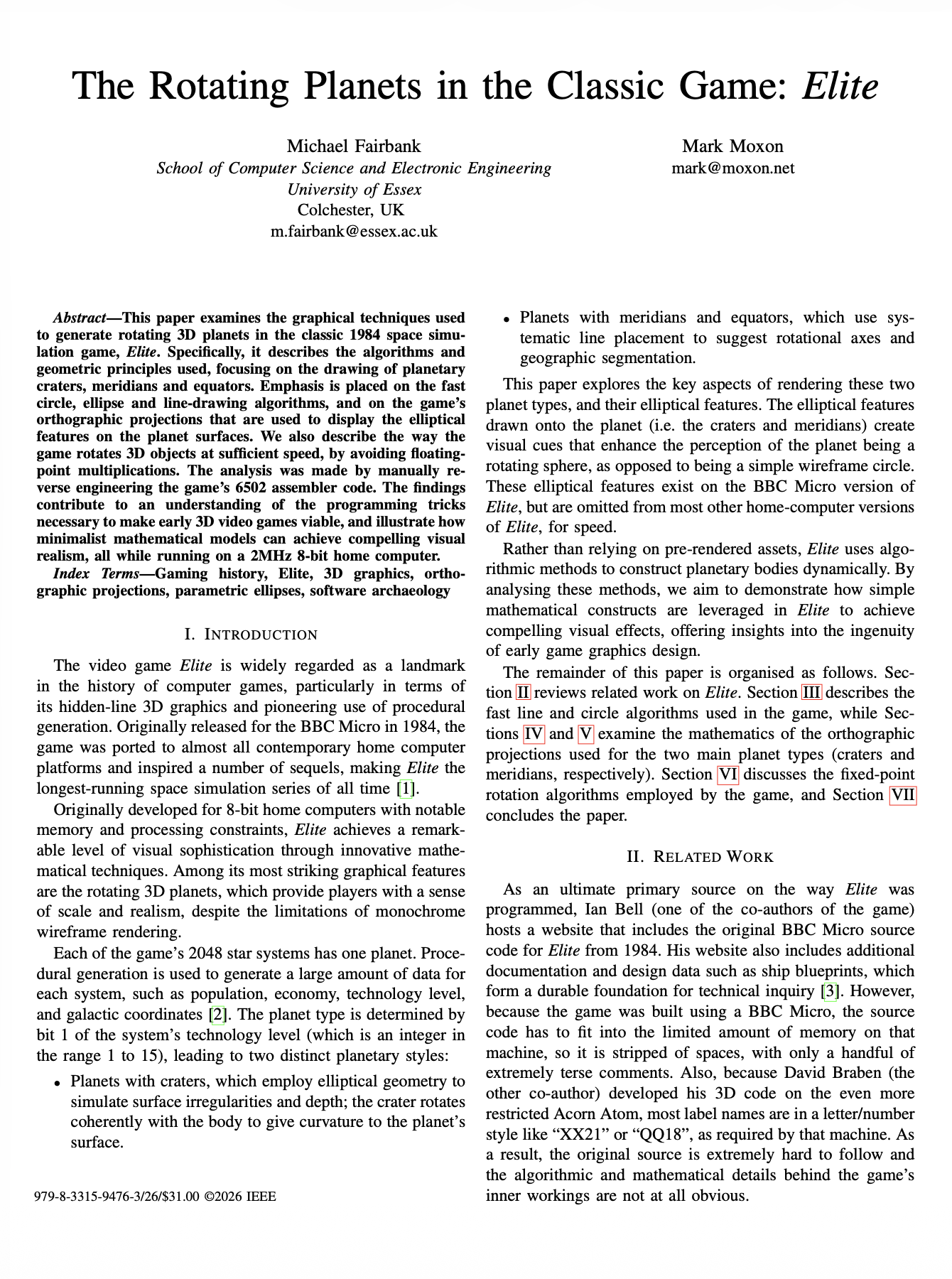
Abstract: This paper examines the graphical techniques used to generate rotating 3D planets in the classic 1984 space simulation game, Elite. Specifically, it describes the algorithms and geometric principles used, focusing on the drawing of planetary craters, meridians and equators. Emphasis is placed on the fast circle, ellipse and line-drawing algorithms, and on the game's orthographic projections that are used to display the elliptical features on the planet surfaces. We also describe the way the game rotates 3D objects at sufficient speed, by avoiding floating-point multiplications. The analysis was made by manually reverse engineering the game's 6502 assembler code. The findings contribute to an understanding of the programming tricks necessary to make early 3D video games viable, and illustrate how minimalist mathematical models can achieve compelling visual realism, all while running on a 2MHz 8-bit home computer.
Analysing the Saturn Loading Screen from the Classic Computer Game: Elite
-------------------------------------------------------------------------
The second paper explores the epic Saturn loading screen, which is a mathematical work of art.
Fairbank, Michael and Moxon, Mark (2026) Analysing the Saturn Loading Screen from the Classic Computer Game: Elite. In: IEEE Conference on Games, 2026-09-01 - 2026-09-04, Madrid.
Free download: https://repository.essex.ac.uk/43578/
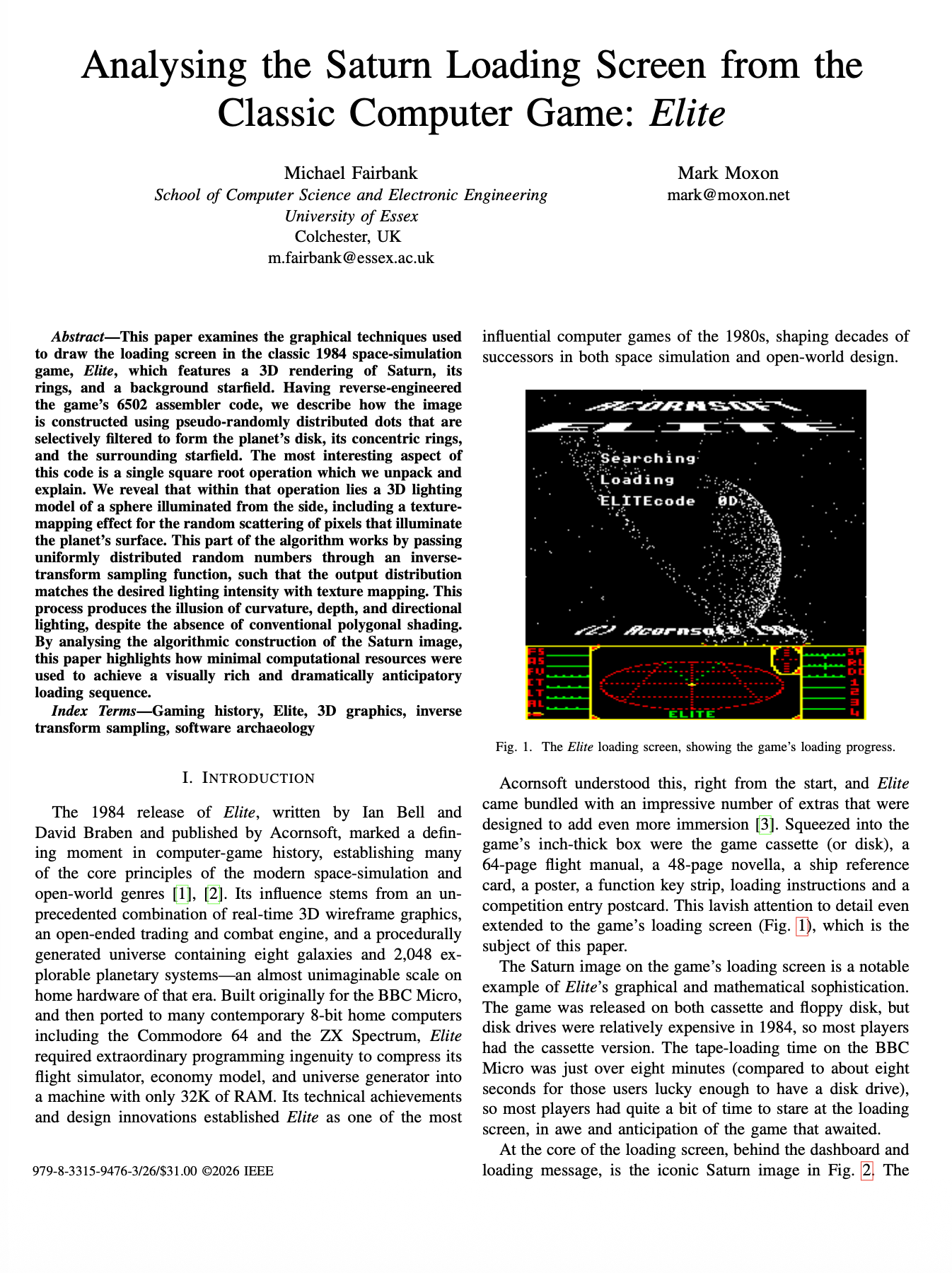
Abstract: This paper examines the graphical techniques used to draw the loading screen in the classic 1984 space‑simulation game, Elite, which features a 3D rendering of Saturn, its rings, and a background starfield. Having reverse-engineered the game's 6502 assembler code, we describe how the image is constructed using pseudo‑randomly distributed dots that are selectively filtered to form the planet's disk, its concentric rings, and the surrounding starfield. The most interesting aspect of this code is a single square root operation which we unpack and explain. We reveal that within that operation lies a 3D lighting model of a sphere illuminated from the side, including a texture-mapping effect for the random scattering of pixels that illuminate the planet's surface. This part of the algorithm works by passing uniformly distributed random numbers through an inverse-transform sampling function, such that the output distribution matches the desired lighting intensity with texture mapping. This process produces the illusion of curvature, depth, and directional lighting, despite the absence of conventional polygonal shading. By analysing the algorithmic construction of the Saturn image, this paper highlights how minimal computational resources were used to achieve a visually rich and dramatically anticipatory loading sequence.