Fully documented source code for Elite, Revs, Lander, Aviator and more
100% handcrafted

My name is Mark Moxon and I'm a software archaeologist and reverse engineer. I love analysing old code, and my aim is to create the best code disassemblies you have ever seen. These are my projects:
- Elite on the 6502 contains fully documented source code for this seminal space sim from 1984, including 130 deep dives into the code and lots of interesting Elite hacks. Covers the BBC Micro, Acorn Electron, BBC Master, Commodore 64, Apple II and NES versions of Elite.
- Aviator on the BBC Micro dissects and documents Geoff Crammond's first simulator, analysing everything from the aerodynamic model of the Spitfire to the flicker-free drawing routines.
- Revs on the BBC Micro examines every single instruction in Geoff Crammond's masterpiece, which is regarded as the grandfather of modern racing sims and is still mind-blowing today.
- The Sentinel on the BBC Micro analyses all the code in Geoff Crammond's uniquely atmospheric curveball, which essentially created its own genre and is rightly revered even today.
- Lander on the Acorn Archimedes pulls apart the first ever game for the ARM platform, which also happens to be David Braben's second masterpiece (after Elite, of course).
- Acornsoft box screenshots contains every box screenshot from every Acornsoft game. Each screenshot has been carefully reconstructed, pixel by pixel and entirely by hand, using scans of the original boxes, magazines and brochures for reference.
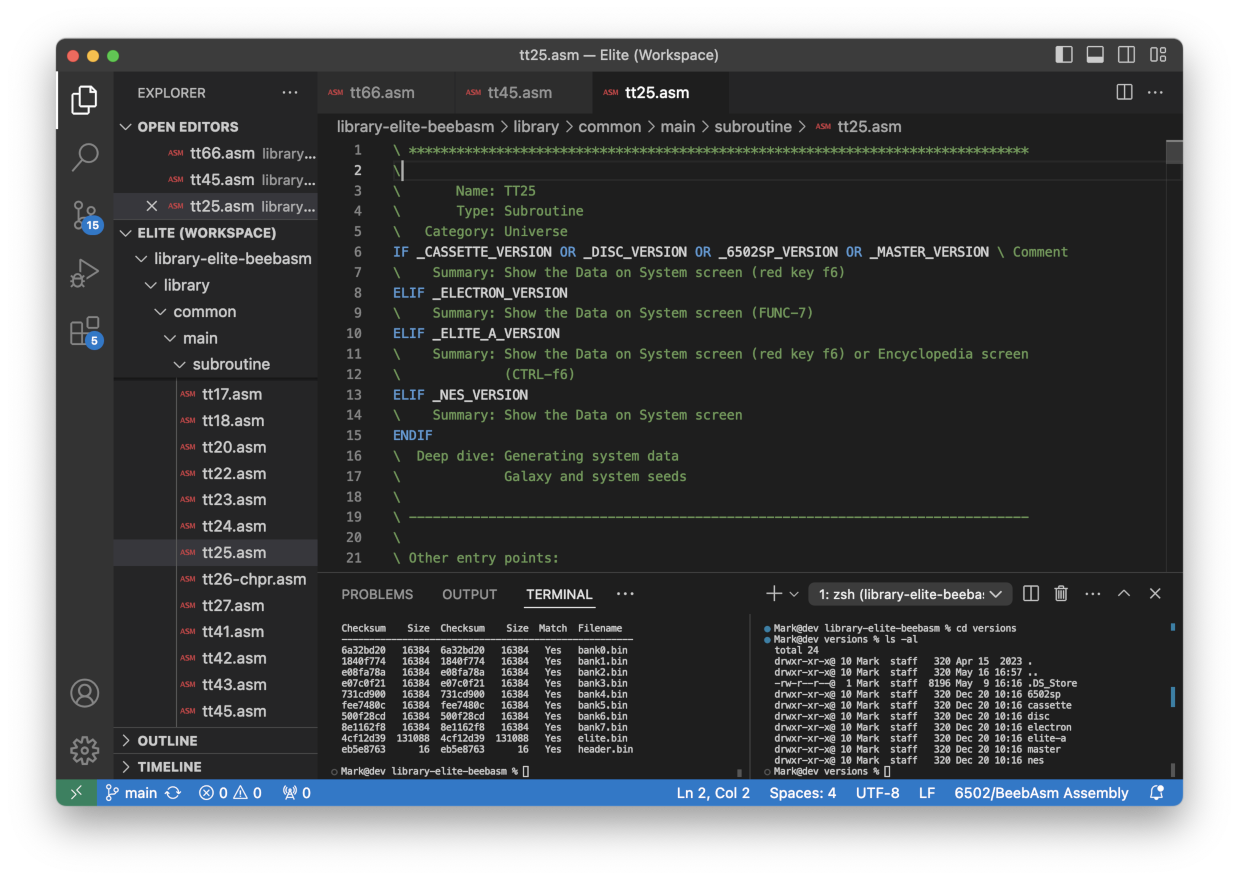
This site also contains lots of extra information about my projects:
- My talks and presentations cover most of my software archaeology projects and might be worth a look if you want to hear me talk about what I do.
- Two academic papers about Elite were published at the 2026 IEEE Conference on Games. I'm a co-author and you can download them for free.
- My disassembly diary describes how I documented The Sentinel, covering every step in the seven-month journey from game disc binaries to fully documented source code. If you want to know how to create disassemblies that are works of art in their own right, then this explains everything.
- Creating my disassembly websites tells the story of how I create and manage so many disassembly websites and repositories using scripts and library repositories.
I post updates and announcements about my projects to Bluesky and Mastodon.
Right on, Commanders!
[X]
All of my sites are 100% handcrafted
I have not used AI at any point in any of my projects.
There's a good reason for this: AI isn't a very good fit for what I do. For me, one of the main attractions of working with old computers is that it is possible for one person to understand every single layer: electrons, logic gates, ICs, CPUs, operating systems and classic games.
I try to keep it this way when I create my disassemblies and hacks and deep dives. I love that fact that it's me working things out. I don't want help, I just want a set of manuals and a simple development environment that doesn't get in the way. This is my handcrafted happy place; I don't want to delegate any of it, if I'm being honest.
Of course, some of the modern development tools I use have been built with AI (and very good they are too). But they're typically emulators or disc imagers that replicate the functionality of old computers, rather than providing AI functionality themselves. My projects may be AI-free, but they obviously exist in a world that isn't.
Visit my disassembly diary to find out more about the tools I use.